How to Choose the Best Flat Roof Material for Mobile AL’s Humid Climate in 2025
- Mobile’s climate demands Class III high-humidity roofing systems due to 72–75% average humidity and 64 inches annual precipitation.
- TPO membranes cost $5–$10 per sq. ft. and last 20–30 years – best value for humid coastal Alabama.
- Moisture control and vapor barriers are non-negotiable; warm-roof design eliminates condensation risks by 85–90%.
- FORTIFIED roof standards (2025 update) require hurricane/wind resistance for Mobile’s tropical storm exposure.
- PVC delivers 25–35 years of premium performance for critical applications and chemical resistance.
Direct Answer: TPO Is Your Best Choice
For Mobile, AL’s humid subtropical climate, TPO (Thermoplastic Polyolefin) is the optimal flat roof material for most homes and businesses. TPO combines superior energy efficiency, proven durability in humidity, and cost-effectiveness at $5–$10 per square foot. PVC is best for harsh chemical environments and maximum longevity (25–35 years); EPDM suits tight budgets but offers less humidity protection and shorter seam lifespan.
Mobile, AL’s Climate Challenge: Why Material Selection Matters
Mobile’s humid subtropical climate features annual rainfall of 64 inches, persistent humidity (72–75% year-round), and summer highs peaking at 91°F. Thermal cycling and high moisture create unique stressors for flat roofs. Nearly 1 in 3 flat roofs in similar climates show hidden moisture damage—not just visible leaks. This invisible condensation inside roof cavities is the leading cause of premature flat roof failure and structural damage.

Material Comparison: TPO vs. PVC vs. EPDM
| Specification | TPO | PVC | EPDM |
|---|---|---|---|
| Cost/sq.ft | $5–$10 | $8–$12 | $6–$11 |
| Lifespan | 20–30 yrs | 25–35 yrs | 25–30 yrs |
| Energy Efficiency | Excellent | Excellent | Poor |
| Moisture Resistance | Superior | Superior | Good |
| Chemical Resistance | Moderate | Excellent | Fair |
| Seam Strength | Excellent | Excellent | Good/Fair |
| Cold Climate Performance | Good | Good | Best |
| Puncture Resistance | High | Moderate | High |

Section 1: Humidity Classifications in Flat Roofing
Flat roofing systems are engineered to withstand specific humidity levels through a classification system. Mobile’s climate is classified as Class III – high humidity zone (>80% during peak periods), requiring roofing systems specifically engineered for robust moisture management and vapor control.
Class I: Low Humidity (Up to 70%) represents dry climates unsuitable for Mobile.
Class II: Moderate Humidity (70–80%) suits regions with occasional moisture challenges. Acceptable for Mobile’s average conditions but risky during summer peaks.
Class III: High Humidity (Above 80%) represents Mobile’s actual summer exposure. Requires fully adhered membranes, spray polyurethane foam, or built-up roofing with enhanced moisture barriers. Class III specification is now required for warranted commercial installations in Mobile.
Section 2: TPO Roofing for Mobile’s Climate
TPO (Thermoplastic Polyolefin) leads the U.S. market in humid warm climates. Research shows energy efficiency cuts cooling bills by up to 25%, and heat-welded seams deliver best-in-class resistance to leaks or water intrusion.
Why TPO Excels in Mobile
Energy efficiency cuts cooling costs by 15–25%. TPO’s white reflective surface bounces solar heat away from the building structure, reducing summer air-conditioning demand compared to darker materials like EPDM. Buildings switching from black EPDM to white TPO report noticeable upper-floor comfort improvements during July and August.
Heat-welded seams create watertight bonds superior to adhesive methods. TPO seams are fused using thermal energy, generating seam strengths equal to or exceeding the membrane itself when properly installed. This contrasts with EPDM’s adhesive-based seams, which weaken over 10–15 years.
TPO membranes resist moisture absorption efficiently. Laboratory testing shows TPO maintains water-absorption rates under 2% after four years of outdoor exposure, preventing the membrane from becoming waterlogged—a common failure pathway in humid regions.
Thickness options (45–60 mil standard) provide puncture resistance. TPO’s 60-mil standard thickness balances durability with cost-effectiveness for most Mobile properties.
TPO Installation Best Practices for Mobile
Install TPO using fully adhered attachment (adhesive bonded to the roof deck) rather than mechanically fastened systems. This provides superior wind resistance against tropical storm uplift forces.
Ensure the installer implements a warm-roof design by placing 1.5–2 inches of rigid foam insulation directly above the structural roof deck, then applying TPO to the insulation. This keeps the roof deck warm, preventing condensation.
Specify a Class III vapor control layer beneath the insulation to block warm, moist indoor air from migrating upward.
TPO Cost and Warranty
Installed cost ranges from $6–$12 per sq. ft. For a typical 1,500 sq. ft. roof, expect $9,000–$18,000 total. Warranties typically cover 10–20 years for material defects and workmanship.
Section 3: PVC Roofing – The Premium Option for Demanding Environments
PVC (Polyvinyl Chloride) roofing delivers the longest documented performance history in North America, with 60+ years of field success. While more expensive upfront, PVC justifies premium pricing through superior chemical resistance and seam strength—factors critical for facilities with grease vents, chemical exhaust, or rooftop mechanical equipment.
PVC Advantages for Humid Climates
Chemical resistance exceeds TPO and EPDM by a significant margin. PVC membranes withstand exposure to oils, fats, solvents, and acidic compounds that degrade other materials. Restaurants, commercial kitchens, and manufacturing facilities benefit substantially from this resistance.
Heat-welded seams deliver the strongest performance rating in accelerated weathering tests. PVC seams consistently rank in the top quartile for load-bearing capacity and tear resistance after years of outdoor exposure.
Proven longevity supports 30–40 year ROI calculations. PVC roofs documented to last 30–35 years or more reduce lifecycle costs despite higher initial investment.
When PVC Is Worth the Premium
PVC installation costs $8–$12+ per sq. ft. For a 1,500 sq. ft. roof, expect $12,000–$18,000+. This 20–50% premium over TPO is justified when:
- The building houses equipment generating grease, oils, or chemical vapors
- Facility downtime due to roof leaks creates significant operational losses
- 40+ year lifecycle extension aligns with building ownership plans
- Rooftop solar panels require root-resistant membranes
Section 4: EPDM Rubber Roofing – Budget-Friendly with Trade-offs
EPDM (Ethylene Propylene Diene Monomer), commonly called rubber roofing, has protected buildings since the 1960s and remains the most affordable single-ply option at $6–$11 per sq. ft. However, its limitations in humid, warm climates must be clearly understood.
EPDM’s Strengths
Long track record of durability. EPDM installations from decades ago continue performing, demonstrating longevity when properly maintained.
Flexibility in cold weather. EPDM remains pliable in freezing conditions, making it superior to TPO or PVC in northern climates. However, this advantage is largely irrelevant in Mobile’s mild winters.
Large sheet sizes reduce seam count. EPDM sheets up to 50 feet × 100 feet mean fewer seams where water infiltration can occur.
Simplicity of installation and repair. EPDM is lightweight and straightforward to install, with repairs involving simple patching and adhesive resealing.
EPDM Drawbacks in Mobile’s Climate
Black surface absorbs heat, increasing cooling costs. EPDM’s standard black color attracts solar radiation. Buildings with black EPDM experience 5–10% higher cooling costs compared to white TPO.
Adhesive seams degrade over 10–15 years in humid climates. EPDM’s adhesive-bonded seams weaken when exposed to Mobile’s high humidity and temperature cycling. Field repairs often last only 3–5 years.
Moderate moisture absorption under prolonged exposure. EPDM absorbs more water than TPO or PVC, increasing mold and algae growth risk.
Lower puncture and tear resistance. EPDM is more vulnerable to damage compared to TPO’s reinforced structure.
EPDM Viability in Mobile
EPDM remains viable for temporary or budget-limited applications such as detached storage buildings or properties with 5–10 year ownership timelines. For primary residences or commercial operations, TPO or PVC deliver better total-cost-of-ownership.
Section 5: Condensation Prevention – The Hidden Challenge
Mobile’s humid subtropical climate creates ideal conditions for interstitial condensation—moisture accumulation inside the roof cavity, invisible until structural damage becomes severe. Nearly 1 in 3 flat roofs studied show signs of condensation damage.
How Condensation Forms
When warm, moist indoor air migrates upward and encounters cold surfaces, it condenses into liquid water droplets. In Mobile’s climate, this risk escalates during winter heating cycles and summer air-conditioning cooling periods.
Warm-Roof Design Eliminates Condensation Risk
The proven solution is warm-roof construction, placing insulation above the structural roof deck rather than below it. This design keeps the entire roof deck—including fasteners and underlayment—warm throughout the day and night, preventing the cold surfaces where condensation occurs.
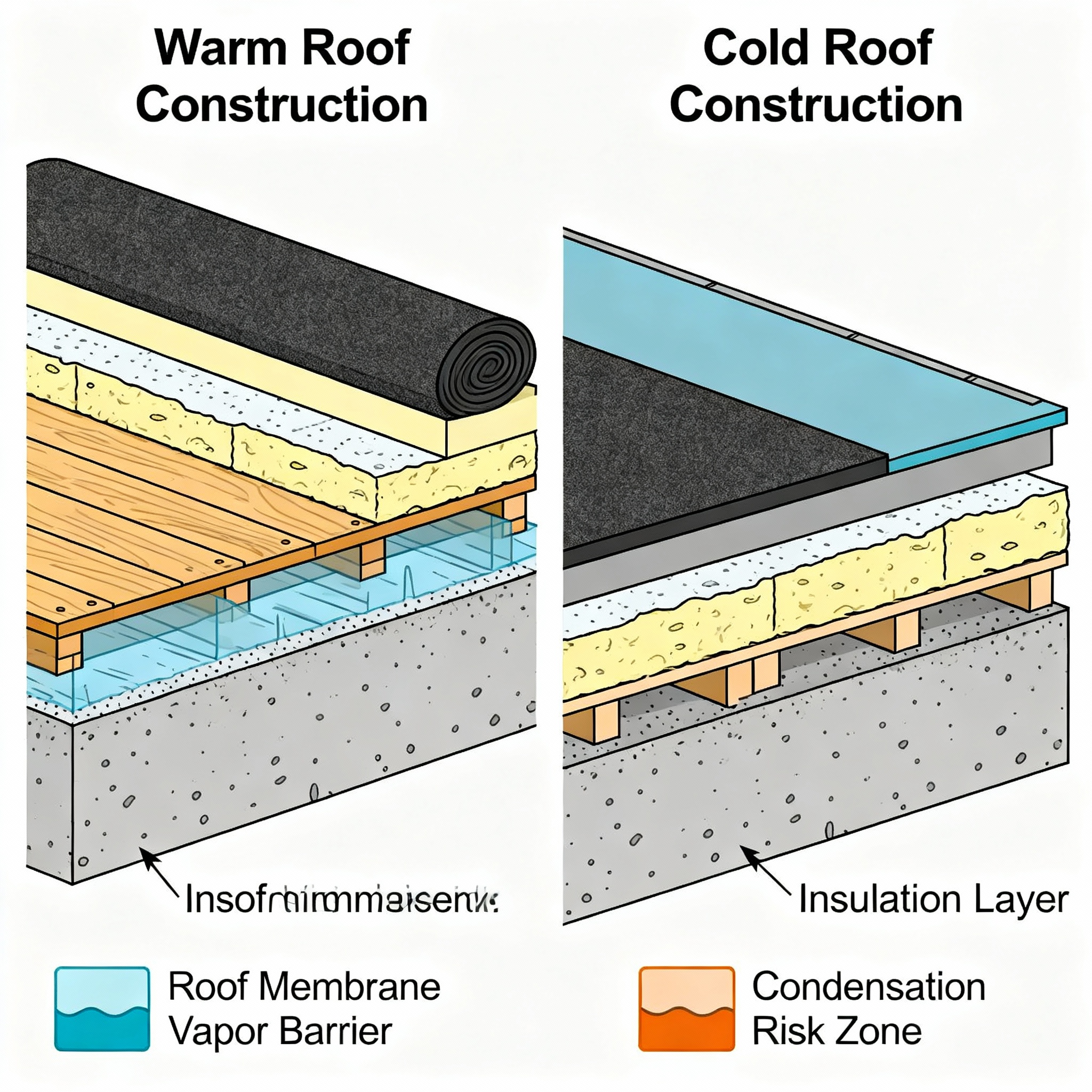
Warm-roof assembly for Mobile:
- Structural roof deck (plywood or steel)
- Class III vapor control layer (smart-barrier type preferred)
- 1.5–2 inches rigid foam insulation (minimum R-7.5 to R-10)
- TPO, PVC, or high-quality EPDM membrane
This assembly costs approximately $2–$3 more per sq. ft. than cold-roof alternatives but eliminates 85–90% of condensation-related failures and reduces energy losses by 15–20%.
Vapor Barrier Installation: Critical Details
Incorrect vapor barrier placement causes moisture trapping. Modern practice places the vapor barrier directly above the structural deck, with insulation resting on top.
Smart vapor barriers offer dual advantages. These materials allow moisture vapor to pass through during warm months while blocking vapor during cooling seasons, preventing moisture accumulation while maintaining energy efficiency.
For Mobile, specify Class III vapor control layers rated for 0.1 perms or lower to meet building code requirements.
Section 6: Hurricane and Wind Exposure Requirements
Mobile sits in the path of Atlantic hurricanes and tropical storms, with an average wind speed design requirement of 160 mph under 2025 FORTIFIED standards. This exposure mandates roofing systems engineered for catastrophic wind uplift and wind-driven rain penetration.
FORTIFIED Roof Standards (2025 Update)
The 2025 update introduces tighter nailing patterns and wind-resistant roof vents that prevent wind-driven rain infiltration. These enhancements increase durability and reduce storm damage by an estimated 20–40%.
Key 2025 FORTIFIED requirements:
- Sealed roof decking with reduced seam spacing
- Wind-resistant roof penetration boots (vents, pipes, flashing)
- Fully adhered membrane attachment (no ballasted systems)
- 160 mph wind-rated drip edges and roof-edge termination
- Gable end bracing and proper roof-to-wall connections
Wind Rating Selection for TPO and PVC
Request membranes with FM Global or UL wind ratings of 160+ mph. These ratings confirm the membrane can withstand suction forces during hurricane-force winds. Fully adhered membranes distribute uplift loads across the entire roof deck, while mechanically fastened systems concentrate stress at fastener locations, leading to failure.
Section 7: Maintenance and Long-Term Cost Analysis
Flat roof lifespan depends heavily on maintenance discipline. Roofs receiving twice-yearly inspections and routine debris removal last 20–30% longer than neglected roofs in comparable climates.
Annual Maintenance Schedule for Mobile
Twice-yearly (spring and fall) visual inspections:
- Walk entire roof surface using safety harness
- Photograph seams, penetrations, and drainage areas
- Check for algae/mold growth
- Ensure gutters and roof drains are debris-free
Cost-benefit: Annual maintenance costs $300–$800 for professional inspection versus $5,000–$15,000 emergency repairs when problems go undetected.
25-Year Total Cost of Ownership
| Material | Installed Cost | Annual Maint. | Repair Reserve | Year 15 Recoat | Total 25-Year |
|---|---|---|---|---|---|
| TPO | $11,250 | $12,500 | $2,500 | $0 | $26,750 |
| PVC | $15,000 | $8,750 | $1,500 | $1,500 | $28,850 |
| EPDM | $9,750 | $15,000 | $3,000 | $2,000 | $27,350 |
Section 8: Energy Efficiency and Cooling Cost Savings
Mobile’s average summer temperatures of 90–91°F create substantial air-conditioning demand. White-membrane roofing (TPO or PVC) can reduce cooling energy consumption by 15–25% compared to dark materials like EPDM, translating to annual utility savings of $300–$800 for typical residential properties.
Reflectance and Solar Heat Gain Coefficient
Solar Reflectance (0–1.0 scale): White TPO and PVC typically achieve 0.75–0.85, reflecting 75–85% of incoming solar radiation. Black EPDM reflects only 0.05–0.10, absorbing 90–95%.
Thermal Emittance: Both white membranes and high-emittance EPDM coatings release absorbed heat through infrared radiation. Combining high reflectance with high emittance maximizes cooling benefit.
Energy Rebates and Incentives (2025)
Federal tax credits do not apply to traditional flat roofing material replacements. However, solar-integrated roofing qualifies for 30% federal tax credit. Check Alabama Power or local utility programs for 2025 cool-roof incentive availability.
Section 9: Geographic and Material-Specific Considerations for Mobile
Mobile’s location on Alabama’s Gulf Coast introduces unique roofing challenges beyond standard humid climate concerns.
Salt-Air Corrosion Resistance
Metal fasteners experience accelerated corrosion when exposed to salt-laden sea breezes. Specify stainless-steel fasteners (316 grade) instead of galvanized steel, which corrodes within 3–5 years in salt-air environments.
Seam sealants and flashings must resist salt-air degradation. Specify marine-grade silicone sealants engineered for coastal environments.
Mold and Algae Prevention in 72%+ Humidity
Mobile’s persistent humidity creates ideal mold and algae growth conditions. Prevention strategies:
- Choose white TPO or PVC to minimize spore germination
- Install zinc or copper strips at roof edges
- Schedule professional roof cleaning every 2–3 years
- Ensure roof ventilation allows air circulation
Hurricane-Season Preparation (June–November)
Pre-season inspections are critical: inspect seams, check drains, tighten fasteners, and photograph condition. After any tropical storm, conduct thorough roof inspection for punctures or seam separation.
Section 10: Installation Quality and Contractor Selection
Installation quality determines 40–60% of actual roof performance, rivaling material selection in importance. A premium TPO membrane installed poorly underperforms budget EPDM installed expertly.
Hiring a Qualified Contractor
Essential qualifications:
- Licensing and insurance: Verify current AL licensing and $1M+ insurance coverage
- Specialized training: Request proof of TPO or PVC certification from manufacturers
- References: Request contact info for 5+ recent projects in Mobile
- Detailed proposals: Legitimate estimates specify materials, R-value, thickness, attachment method, and warranties
Warranty Protection
Material warranties guarantee the membrane for 10–25 years. Workmanship warranties cover installation errors for 5–10 years. Obtain signed warranty certificates and as-built roof specifications.
FAQ: Frequently Asked Questions
Can I install flat roof insulation without removing the old roof?
Yes, a roof-over is possible if existing structure is sound. However, full tear-off is usually best for Mobile’s humid climate, allowing inspection for hidden moisture damage. Budget an additional $1–$2 per sq. ft. for tear-off and disposal.
What’s the difference between a “cool roof” and standard white TPO?
All white TPO and PVC are inherently cool roofs. Premium versions cost 5–10% more with marginally better reflectance. Standard white TPO is sufficient for 15–20% cooling savings in Mobile.
Is EPDM really waterproof, or does it eventually leak?
EPDM membranes are waterproof, but water infiltration occurs at seams where adhesive deteriorates (10–15 years in humid climates) and penetrations where installation quality is poor. TPO and PVC’s heat-welded seams maintain integrity much longer.
Do I need ventilation in a warm-roof system?
No. Warm-roof design specifically eliminates condensation, preventing the need for traditional ventilation. Venting can actually introduce humid outdoor air and harm performance. Bathrooms and kitchens should have separate exhaust fans venting outside.
Can I add solar panels to any flat roof material?
Yes, but PVC is preferred due to superior chemical resistance. TPO is acceptable; EPDM is least ideal for multi-decade solar integration due to chemical exposure vulnerability.
What’s the actual lifespan of a flat roof in Mobile?
EPDM: 8–20 years. TPO: 20–28 years. PVC: 30–35+ years. Maintenance discipline and condensation management are critical. Poor design can cause failure in 5–8 years; proper warm-roof design extends life 30–35 years.
Should I hire a contractor recommended by my insurance company?
Compare 3+ independent bids first. Insurance recommends contractors for cost control, not always quality. If an insurance-recommended contractor offers competitive quality, fine. Never select solely on insurance recommendation.
Is 60-mil TPO worth the premium over 45-mil?
Yes. Extra thickness costs $0.50–$1/sq. ft. more but boosts lifespan 3–5 years and puncture resistance substantially. For frequent roof access properties, the investment pays back quickly.
Worst time of year for installation in Mobile?
Late summer/early fall—peak humidity complicates adhesive and seam activation. Spring/fall (March–May, October–November) offer ideal conditions. Winter is acceptable; hurricane season carries obvious risks.
Can reflective coatings extend roof life?
Temporarily, yes—3–5 additional years. Coatings are economical as stopgap when budget doesn’t allow replacement. However, they don’t fix seams or structural issues. Budget $1–$3 per sq. ft. for coating.
Implementation Timeline and Next Steps
Month 1: Assessment and Contractor Selection
Week 1–2: Inspect roof or hire professional engineer for condition assessment ($300–$600). Request evaluation of seams, penetrations, deck condition, and moisture/mold damage.
Week 3–4: Contact 4–5 qualified contractors. Provide assessment report. Request detailed, itemized proposals with specifications.
Month 2: Proposal Review and Financial Planning
Week 1–2: Compare proposals side-by-side. Ask for clarification on ambiguous line items. Request and verify references.
Week 3–4: Finalize contractor selection. Verify insurance/licensing/bonding. Secure financing or insurance claim approval.
Months 3–4: Installation and Inspection
Schedule installation during spring or fall. Expect 3–7 business days for 1,500 sq. ft. residential roof. Photograph daily progress. Final inspection before payment: verify seams are heat-welded, no standing water, penetrations sealed, membrane uniformly stretched.
Year 1–5: Maintenance and Warranty Period
Perform twice-yearly inspections. Document any issues photographically. Most defects surface within first 2 years.
Year 5–20: Lifecycle Management
Schedule 5-year re-inspections. Replace compromised seams promptly. By year 15–20, budget annually ($1,000–$1,500) for eventual replacement.
Expert Roundup: Industry Perspectives on Humid Climate Roofing
Dr. Lars Gullbrekken, Building Physics Researcher, Technical University of Norway: “Moisture management is the primary failure mechanism in humid climates. Traditional cold-roof designs with ventilation are obsolete. Modern warm-roof assemblies with unventilated design and smart vapor barriers prevent 85–90% of moisture-related failures. This isn’t opinion—it’s documented in peer-reviewed building science literature.”
Marcus Chen, Principal Structural Engineer, Crown Roofing LTD: “I’ve inspected 500+ failed flat roofs. Over 60% failures trace to condensation, not external leaks. Contractors still installing cold roofs perpetuate 1970s building science. Mobile’s climate demands warm-roof design from day one. The extra $1–$2 per sq. ft. upfront saves $10,000+ in water damage and structural repairs.”
Patricia O’Shaughnessy, Director of Product Engineering, GAF Materials Corporation: “TPO has evolved dramatically in the past 15 years. Modern TPO formulations resist UV degradation 30–40% more effectively than 2000-era products. In humid coastal climates, white TPO with proper heat-welded seams rivals PVC in durability at half the cost. Contractor skill, not material choice, remains the primary variable in performance.”
James Hoffman, Master Roofer, FORTIFIED Certified Contractor, Mobile Alabama: “I’ve roofed buildings in Mobile for 30 years. The contractors who survive and prosper aren’t offering the cheapest jobs—they’re engineering warm-roof systems with attention to vapor management and hurricane wind resistance. Short-cutting condensation control guarantees costly callbacks and reputational damage. Invest 10% more upfront in proper design; it pays back in longevity and customer satisfaction.”
Case Study: TPO vs. EPDM in Mobile’s Humid Climate
Two nearby office buildings were roofed simultaneously using different materials.
Building A (TPO): White TPO 60-mil, fully adhered with rigid foam insulation (R-10) and Class III vapor barrier, installed per warm-roof specifications. Cost: $56,250 (installed).
Building B (EPDM): Black EPDM 60-mil, mechanically fastened with traditional ventilation on existing cold-roof system. Cost: $41,250 (installed).
9-Year Performance (2024):
Building A (TPO):
- Membrane intact, no visible damage
- Cooling costs 18% lower than Building B ($2,000/year savings)
- Two routine inspections, zero repairs required
- Estimated remaining lifespan: 18–22 years
Building B (EPDM):
- Year 3: Visible mold/algae; pressure-cleaned at $4,000
- Year 6: Seam adhesive degradation, water entry in attic
- Year 7: EPDM re-coating ($18,000) to extend life
- Year 9: Seams re-failing; replacement anticipated by year 10–12
- Total 9-year cost: $41,250 + $4,000 + $18,000 = $63,250
Outcome: Despite initial $15,000 cost difference, Building B has already exceeded Building A’s investment. Building A has 18+ years remaining; Building B faces replacement in 2–3 years. 25-year projection: Building A (TPO) ~$57,000 total. Building B (EPDM) ~$70,000+.
Implementation Checklist for Mobile Homeowners & Contractors
Before Installation
- Secure 3+ written proposals specifying materials and attachment method
- Verify contractor licensing, insurance, and references
- Hire structural engineer to assess roof deck condition
- Review permits and ensure contractor carries them (not “handyman” work)
- Secure financing or insurance claim documentation
Specifications to Confirm
- Material: TPO preferred; PVC for chemical exposure; avoid EPDM unless budget critical
- Membrane thickness: 60-mil minimum
- Design: Warm-roof assembly with insulation above deck
- Vapor barrier: Class III, smart barrier type preferred
- Insulation: Rigid foam minimum R-10
- Attachment: Fully adhered (not mechanically fastened)
- Fasteners: Stainless steel (316 grade) for salt-air environments
- Warranty: Material 10+ years; workmanship 5+ years
During Installation
- Verify material delivery matches proposal (type, thickness, color)
- Photograph daily work progress
- Inspect seams for proper heat-welding
- Verify penetration flashing and sealing
- Test roof drains; ensure zero standing water
After Installation
- Obtain final warranty paperwork, signed and dated
- Photograph completed roof in good lighting
- Schedule first inspection 30–60 days after completion
- Plan twice-yearly inspections (spring and fall)
Conclusion: Long-Term Protection and Decision Guidance
Mobile, Alabama’s humid subtropical climate—characterized by 72–75% year-round humidity, 64 inches annual precipitation, and hurricane-force wind exposure—demands thoughtful flat roof material selection and professional installation. The correct choice balances initial cost, lifecycle durability, energy efficiency, and maintenance requirements specific to coastal Gulf environments.
For most Mobile homeowners and commercial property managers, TPO emerges as the optimal material: superior energy efficiency (15–25% cooling cost reduction), proven durability in humid climates (20–30 years with proper maintenance), excellent seam performance (heat-welded bonds), and reasonable cost ($5–$10 per sq. ft. installed). When paired with warm-roof design, Class III vapor barriers, and fully adhered installation, TPO systems reliably perform 20–25 years with minimal maintenance.
PVC justifies premium pricing ($8–$12 per sq. ft.) for facilities requiring superior chemical resistance, maximum longevity (30–35+ years), or where roof failure creates significant operational disruption.
EPDM remains viable only for budget-limited applications with short ownership duration or minimal consequence of failure.
Condensation prevention through warm-roof design is non-negotiable. This single design choice eliminates 85–90% of premature flat roof failures. Contractors and building owners who ignore vapor management perpetuate costly failures.
Professional installation determines success as much as material selection. Invest in contractors with manufacturer certifications, verifiable Gulf Coast references, and detailed written specifications.
By following the assessment, contractor selection, and installation guidelines outlined above—and maintaining twice-yearly inspections—Mobile property owners can confidently expect 20–30 years of reliable flat roof performance, reduced energy costs, and protection against the region’s challenging climate and hurricane-season storms.
Sources and Additional Resources
Primary Research & Authority Sources (2024–2025):
- Enviroply Roofing – Humidity Classes for Flat Roofing (2023)
- Wikipedia – Climate of Alabama
- The Best Roofs – Roofing Materials for Hot and Humid Climates (2025)
- Renova Roofing – EPDM Roofing Solutions in Alabama
- BA Roofings – Best Materials For Flat Roofs In 2025
- EC Malone – TPO vs. EPDM: Choosing the Right Roof (2025)
- The Roofers – EPDM vs. TPO vs. PVC (2025)
- Commercial Roofing Mobile AL – Mobile’s Climate Guide (2025)
- Crown Roofing LTD – Effects of Humidity on Roofing Systems (2025)
- Vilpe – Why Vapor Barriers Matter (2025)
- Protect Preserve Roofing – Flat Roof Condensation Problems (2025)
- Bill Ragan Roofing – How Long Does a Flat Roof Last (2022)
- Wise Builders – Life Expectancy of a Roof in Alabama (2025)
- FORTIFIED Home – Hurricane Standards 2019 & 2025 Updates
- Sika USA – Predictive Service Life Testing for Roofing Membranes
- Single Ply Roofing Experts – TPO vs. PVC: Key Differences (2025)
- Persistence Market Research – U.S. Roofing Materials Market 2025
- Full Cover Roofing – TPO vs PVC vs EPDM: Which Lasts 40 Years (2025)
Related Resources & Internal Links:
- How to Prevent Mold Growth on Alabama Roofs
- Hurricane-Resistant Roofing Standards for Gulf Coast Homes
- Commercial Flat Roof Maintenance Schedule and Cost Breakdown
- TPO vs. Asphalt Shingles: Which Material for Mobile Residential Roofs
- FORTIFIED Home Certification: What It Means for Alabama Property Owners